
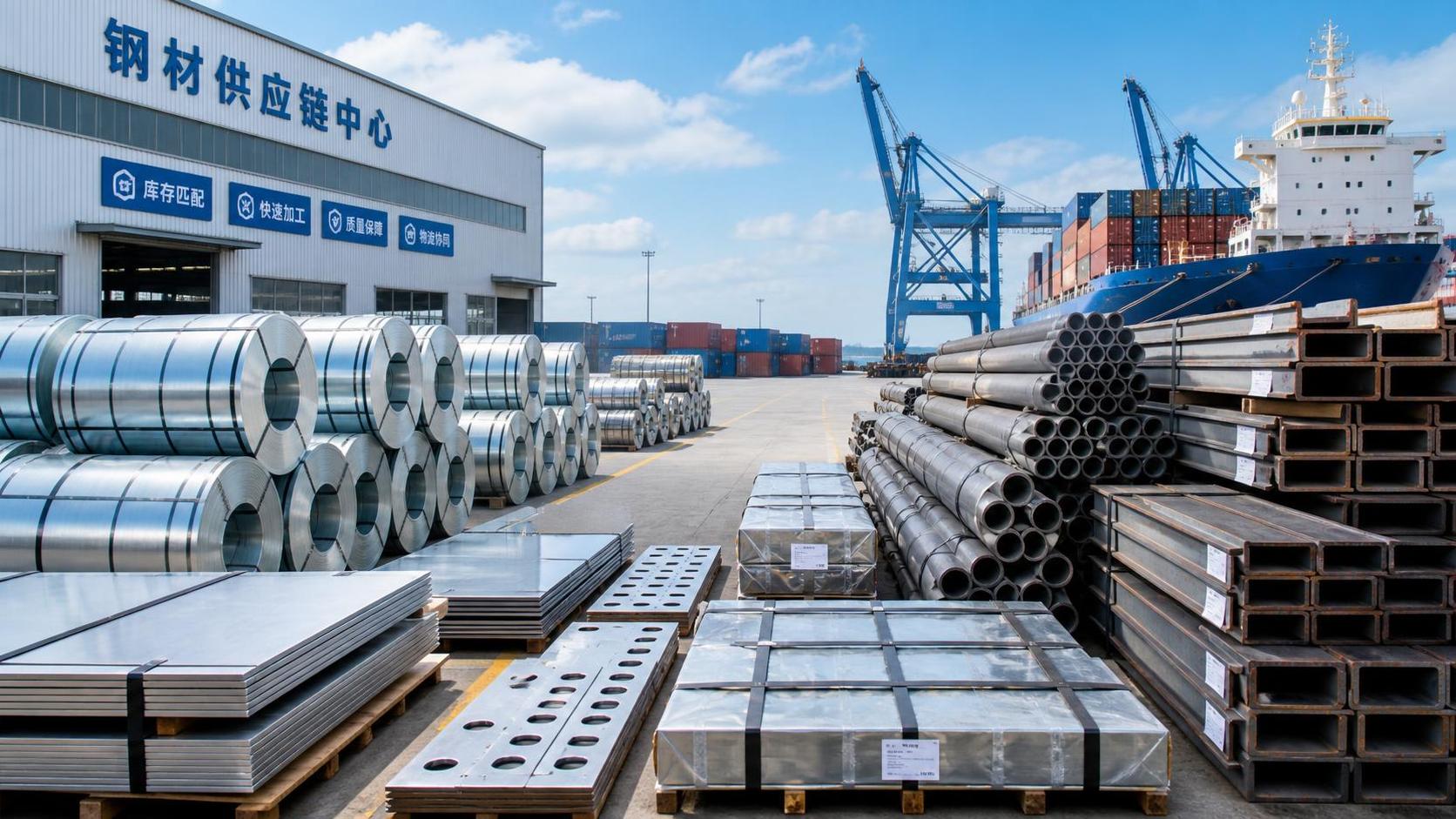
For procurement and evaluation teams facing urgent project demand, the real question is not whether steel can be sourced somewhere in the market. It is whether the supply chain behind that order can compress time without creating new risk in quality, documentation, or total landed cost. In steel purchasing, lead time is rarely determined by mill production alone. It is shaped by how fast a supplier can match stock, arrange processing, consolidate transport, clear export procedures, and keep information moving without gaps. That is where capable Steel Supply Chain Services become commercially relevant.
Urgent orders expose weaknesses that routine purchasing can hide. A standard replenishment cycle allows more room for production slots, document corrections, transport delays, and internal approval loops. An urgent order does not. If a buyer needs stainless plate, galvanized coil, carbon steel tube, or structural profiles within a compressed schedule, every handoff matters. A delay of two or three days at the wrong point can turn into a missed fabrication window, a stalled construction sequence, or higher emergency freight cost later in the chain.
Lead time in steel procurement is usually lost between nodes, not at one single point
Many buyers still discuss lead time as if it were only a mill issue: how many days to roll, cut, or galvanize a product. In practice, the timeline is fragmented. Material availability, specification confirmation, testing records, processing arrangement, trucking to port, vessel booking, customs coordination, and destination handling each take time. When these activities are managed by separate parties with separate incentives, the order moves at the speed of the slowest response.
This is why urgent fulfillment often favors providers that work as supply chain coordinators rather than pure traders. The value is not simply “having steel.” It is having access to inventory visibility, nearby processing capacity, transport options, and export execution in one operating model. In port-connected regions such as Shandong, this can matter even more, because the advantage is not only physical proximity to cargo routes but also familiarity with how to move steel products through them efficiently.
For evaluation teams, the first useful shift in thinking is this: when an order is urgent, compare service architecture before comparing unit price. A low base price on steel that cannot be processed, packed, documented, and dispatched on time is usually not a lower-cost option in the full commercial sense.
What responsive supply chain service actually changes for urgent orders
When service providers claim they can reduce lead time, buyers should break that promise into operational components. Some claims are meaningful; others are too vague to support a decision.
1. Faster inventory matching
The most obvious time reduction comes from stock availability. But “stock” needs careful interpretation. It may mean ready goods in a warehouse, coil available for slitting, plate available for cutting, or upstream mill allocation that is not yet physically accessible. These are not the same thing. For an urgent order, procurement teams should ask whether the service provider can identify exact available material by grade, thickness, width, finish, length range, heat number status, and quantity split.
If a provider can quickly match the request to available stainless steel, carbon steel, galvanized products, or structural profiles across multiple stock points, the order can bypass the longest part of the traditional cycle. This is especially useful when end-use tolerances allow alternative dimensions or processing routes. A strong supply chain service team will often propose commercially acceptable substitutions or conversion paths that save time without moving the buyer outside project requirements.
2. Processing without restarting the supply chain
Urgent steel orders are often not urgent because the steel itself is rare. They are urgent because the steel must arrive in a usable form. Cutting, slitting, leveling, recoiling, beveling, tube length customization, surface treatment, and profile preparation can each add delay if they require a separate vendor and a separate queue.
A provider that can coordinate processing close to inventory or close to port reduces handling and communication lag. That does not guarantee the shortest lead time in every case, but it removes one of the most common causes of avoidable delay: steel arriving on schedule but not in the required condition for fabrication or installation.
Buyers should pay attention to one practical issue here. Every extra processing step can shorten schedule but also increase error exposure. For urgent orders, the right question is not “Can you process it?” but “How do you control dimensional confirmation, scrap allowance, and inspection after processing?” Speed without process control simply moves the problem downstream.
3. Port-based logistics that shorten transfer time
For export-oriented procurement, logistics positioning can have a measurable impact on lead time. A provider linked to a major port cluster may reduce inland transfer distance, improve access to vessel schedules, and simplify container or break bulk coordination depending on cargo type. This matters differently for coils, tubes, plates, and structural profiles because handling methods and loading constraints differ.
Plates and structural profiles may require more careful truck scheduling and port handling windows. Tubes and coils may raise different packing and consolidation issues. If the service provider understands these cargo-specific details, they can often plan dispatch around booking realities instead of treating logistics as a final step after the sale is already made.
In this respect, a company positioned as a global steel supply chain service provider leveraging the Shandong port cluster is relevant as a business model, not as a slogan. For urgent export orders, port adjacency can reduce coordination layers, particularly when the same team is managing stock confirmation, processing arrangements, and shipping execution.
4. Documentation readiness
Procurement teams sometimes underestimate how often urgent steel shipments are delayed by paperwork rather than metal. Material test certificates, packing lists, invoice details, origin documents, customs coding, and destination-specific compliance paperwork can become bottlenecks if they are assembled late or inconsistently.
For evaluation purposes, this is one of the easiest areas to test. Ask the provider how early they prepare export documents, how they reconcile certificates with actual shipment lots, and how they handle changes in split quantities or mixed-product shipments. A responsive supply chain service should be able to explain this clearly. If the answer stays at the level of “we usually manage it,” there is a process risk.
Why urgent orders are often more expensive than buyers expect
Reducing lead time does not always reduce direct purchase price. In fact, urgent orders commonly increase the visible steel price because buyers are asking the market to prioritize speed over perfect production economics. The mistake is to stop the analysis there.
Commercially, the relevant comparison is broader:
- price premium for near-term stock versus mill-order pricing
- processing charges for accelerated customization
- packing and logistics adjustments for faster dispatch
- risk of non-compliance or rework under compressed timing
- cost of project delay if delivery slips
In many steel categories, the last factor outweighs the first three. A lower-priced order that misses a production slot, fabrication schedule, or site installation window may create costs that are not booked under procurement but are very real for the business. This is why experienced evaluation teams look at total schedule cost, not only material line-item cost.
That said, buyers should not assume that “urgent” justifies any premium. Service providers still need to show where time is being saved and what tradeoffs are involved. If the provider cannot separate material premium from logistics premium and service premium, cost transparency is weak.
What to verify before relying on a supply chain partner for urgent steel demand
Evaluation teams should test capability through operating details, not broad claims. A useful supplier discussion often includes the following checks:
These checks are not theoretical. They help buyers distinguish between a company that occasionally handles urgent orders and one that is structurally built for them.
Some common claims sound reassuring but need qualification
Several phrases appear frequently in steel sourcing discussions and can mislead decision-makers if taken at face value.
“We always have stock.”
No steel supplier has everything available in every grade, size, finish, and quantity at all times. The real issue is whether the supplier can identify suitable stock quickly and state the limits clearly. For urgent procurement, precise shortage disclosure is often more useful than broad availability claims.
“Port location guarantees fast delivery.”
Port access helps, but only when inventory, processing, booking, and document flow are aligned. A port-based supplier with poor internal coordination may still lose time. Conversely, a slightly less advantaged location with strong process control can outperform a better-located but fragmented competitor.
“One-stop service lowers all costs.”
Integrated service can reduce hidden costs and shorten cycle time, but not every bundled service is economically efficient. Buyers should still evaluate whether each layer of handling adds value. The best providers simplify the chain; weaker ones merely absorb steps and mark them up.
“Urgent orders can be treated like normal orders, just faster.”
This is one of the more costly assumptions. Urgent orders require tighter exception management, quicker technical confirmation, and stronger discipline around substitutions, packaging, and shipment sequencing. If the provider does not adapt its control method, speed increases the chance of mismatch.
Where this model is most useful, and where it is less effective
Responsive steel supply chain service is most valuable when the buyer faces one or more of these conditions: fluctuating project schedules, export complexity, incomplete demand visibility, mixed-product orders, or a need to combine stock sourcing with value-added processing. It is also relevant when a procurement team wants fewer counterparties during time-critical fulfillment.
Typical scenarios include replacement material for fabrication delays, supplemental tonnage for construction schedules, export orders that combine plates, coils, tubes, and profiles, and orders where standard mill lead time no longer fits the project clock.
It is less decisive when demand is highly stable, specifications are narrow and repetitive, and the buyer can plan mill orders well in advance. In that case, long-cycle direct procurement may still deliver the best economics. Not every steel purchase needs an accelerated service model. The business case becomes stronger as uncertainty and delay cost increase.
A practical evaluation approach for procurement teams
For buyers comparing suppliers, the most useful approach is to run a scenario-based evaluation instead of a generic capability questionnaire. Present a realistic urgent order case: product type, specification, quantity, destination, required delivery date, and whether processing is needed. Then ask each supplier to respond with a feasible execution path, not just a quotation.
The response should reveal how they think. Do they clarify stock condition? Do they flag specification risks early? Do they explain whether the lead time depends on stock, processing queue, or vessel timing? Do they distinguish firm commitments from provisional estimates? A supplier that can answer these questions cleanly is often safer to work with under time pressure than one offering a more attractive but less structured promise.
For companies active in export supply from China, especially through established industrial and port regions, the strongest partners are usually those that combine commercial flexibility with operational discipline. A business such as Handong Rongxin Metal Manufacturing Co., Ltd., positioned around stainless steel, carbon steel plates, tubes, coils, galvanized products, and structural profiles, fits the type of provider that may be relevant in this context, provided the actual execution capability matches the service claim. That distinction matters. Procurement decisions should be made on verified process performance, not on category coverage alone.
In urgent steel procurement, time is only partly a logistics problem and only partly a sourcing problem. It is mainly a coordination problem. The providers that reduce lead time most effectively are the ones that remove waiting time between decisions, between parties, and between physical steps. For evaluation teams, that is the point worth focusing on: not who sells steel fastest in theory, but who can keep the order moving when the schedule leaves no room for hesitation.
Please give us a message
We welcome your interest in our products and welcome your request for customization. We look forward to establishing successful business relationships with new clients around the world and providing high-quality services for projects in diverse fields.


