
Meta Title: Which Steel Tube Works Better for Pressure Lines and Structural Use
If you are choosing a Steel Tube for both pressure service and structural work, the short answer is this: one tube rarely performs best in both roles without checking the operating conditions first. For pressure lines, material grade, wall thickness, code compliance, and corrosion behavior matter more than shape alone. For structural use, load path, weldability, dimensional consistency, and section efficiency usually drive the decision. The right choice depends on what the tube actually has to carry, how it will be fabricated, and what kind of risk your project can tolerate.
A lot of selection mistakes happen because people treat steel tube as a general commodity. In practice, a tube for compressed air, water, oil, steam, or process media should not be evaluated the same way as a tube used in frames, supports, columns, braces, or equipment skids. The material may look similar on paper, but the service demands are not.
Where most projects go wrong when selecting Steel Tube
One common misunderstanding is assuming that “stronger” automatically means “better.” It does not. A higher-strength steel tube can help in structural applications by reducing section size or weight, but that same choice may complicate welding, sourcing, inspection, or code approval for pressure service. Another mistake is choosing by price per ton instead of installed cost. A cheaper tube that needs extra coating, more frequent replacement, tighter fabrication control, or special fittings can become the expensive option once the job is underway.
There is also a habit of comparing round tube, pipe, hollow structural sections, and mechanical tubing as if they belong to one interchangeable group. They do not. The manufacturing standard behind the product matters. For pressure lines, the governing specification and testing requirements are often the first filter. For structural use, section properties, straightness, tolerances, and connection details usually matter more.
If you need a quick working rule, use this: for pressure lines, start from service conditions and applicable code; for structural use, start from loads, connections, and fabrication method. Then see whether one material family can satisfy both without compromise.
Pressure lines: what actually matters
When a steel tube is used in pressure service, the key question is not “Will it hold?” in a general sense. The better question is “Will it hold safely for the design life under this pressure, this temperature, this medium, and this maintenance reality?” That is a different level of judgment.
For many industrial pressure lines, carbon steel is still the practical first option because it is widely available, familiar to fabricators, and cost-efficient. It works well when the fluid is non-aggressive, the environment is manageable, and the design stays within the limits of the relevant standard. But carbon steel is not forgiving in corrosive service or where internal scaling and long-term wall loss are likely. In those cases, stainless steel tube often becomes the better choice, even when its purchase price is higher.
What should you check first?
- Fluid or gas type
- Operating pressure and temperature
- Corrosion risk, both inside and outside the line
- Required standard or project specification
- Welded or seamless preference, if mandated
- Inspection, testing, and traceability requirements
For clean water, air, general utility service, or non-severe process conditions, carbon steel tube or pipe can be fully reasonable if the design standard allows it. For chemical exposure, chlorides, food-grade systems, or environments where rust contamination is a problem, stainless steel tube is often the safer decision. Not because stainless is “premium,” but because it reduces a specific failure risk that carbon steel cannot manage well without extra protection.
Another detail people overlook is fabrication. Some pressure systems look simple in the drawing stage but involve a lot of field welding, branch connections, and fit-up correction. In that situation, material consistency and weld response matter. If the tube is sourced without stable quality control, the job may pass procurement but fail in production through rework, delays, or inspection trouble.
Structural use needs a different lens
When the same conversation shifts to structural use, the priorities change. The section must carry compression, bending, torsion, vibration, connection loads, and sometimes impact. A steel tube that performs well as a pressure boundary is not automatically the most efficient choice as a structural member.
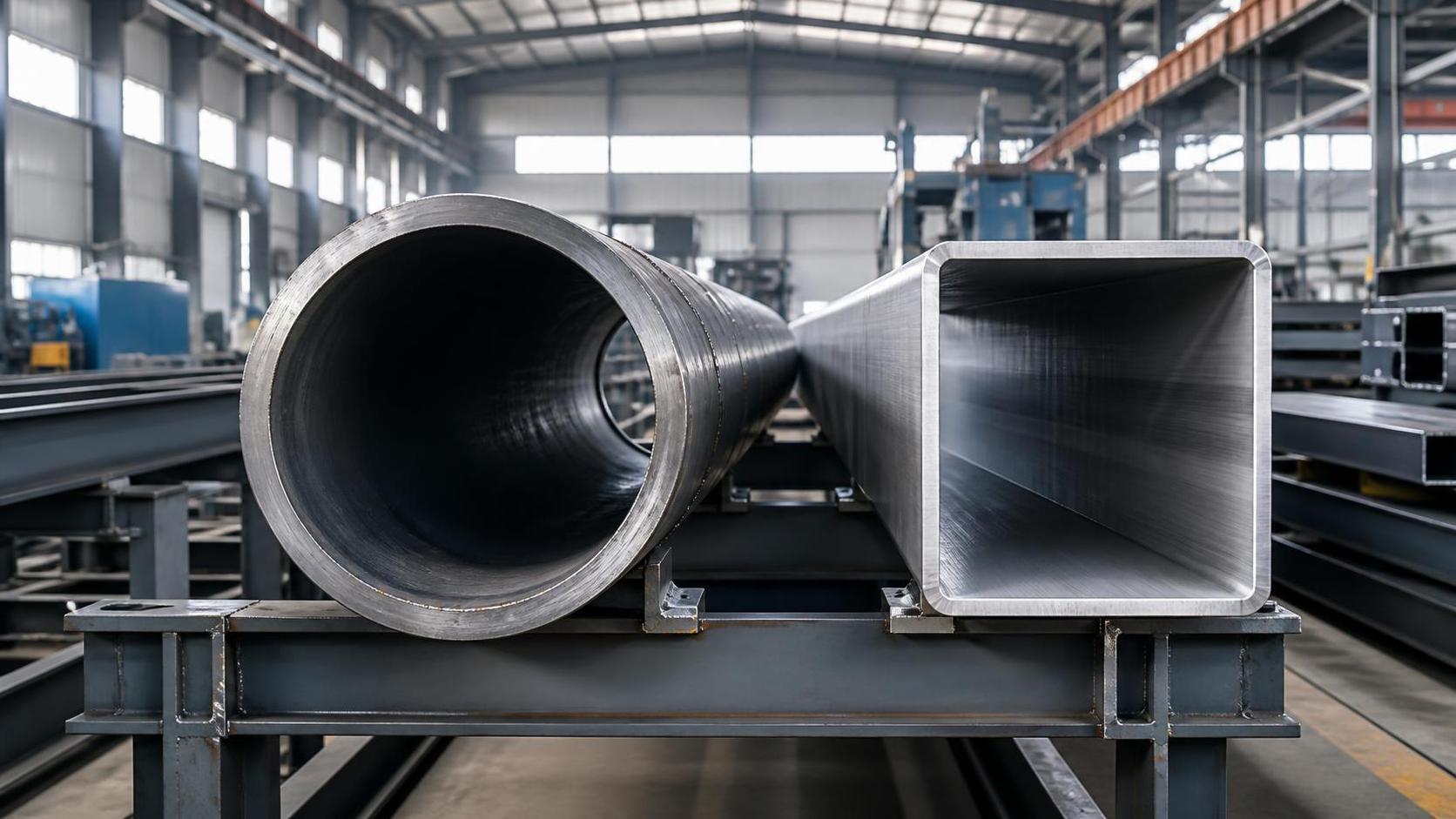
Round steel tube has excellent torsional behavior and a clean appearance, so it works well in trusses, frames, architectural members, guard structures, and machine supports. Square and rectangular hollow sections are often easier to connect and more efficient where flat surfaces help with welding, bolting, or cladding. If the project involves repetitive fabrication, these practical shop advantages matter a lot.
For structural applications, focus on these questions:
- Is the load mainly axial, bending, or combined?
- Will the member be welded heavily on site or in shop conditions?
- Do you need tight dimensional consistency for assembly?
- Is corrosion protection built into the design, or added later?
- Will local buckling or connection detailing control the design?
Many project teams spend too much time debating steel grade and not enough time on connection design. In real projects, weak detailing causes more trouble than the nominal base material. A good structural tube selection is one that fits the joint design, fabrication workflow, and inspection method without creating avoidable complexity.
Can one Steel Tube serve both pressure and structure?
Sometimes yes, but only in limited cases and usually with trade-offs.
For example, equipment skids, handrail systems with utility routing, modular plant frames, and certain packaged units may use tube members that carry light structural duty while also housing or supporting process lines. Even then, the pressure-carrying component usually has to be selected to pressure requirements first. Structural convenience comes second.
Where people get into trouble is trying to use structural tubing as a substitute for pressure-rated line material without checking specification, testing, and compliance. That is risky. The reverse can also be inefficient: using pressure-grade tube everywhere in a structure may increase cost without improving structural performance in any meaningful way.
A more disciplined approach is to separate the functions. Let the pressure line be chosen for containment and code compliance. Let the structural steel tube be chosen for load-bearing efficiency and fabrication logic. If a project still wants one product family for supply simplification, that decision should be reviewed carefully by engineering, procurement, and fabrication together.
Carbon steel or stainless steel tube?
This is usually the real decision behind the search.
Carbon steel tube makes sense when the service is moderate, coatings or external protection are practical, and lifecycle corrosion risk is acceptable. It is usually easier on budget and easier to source in large volumes. That is why it remains common in industrial utilities, support structures, general fabrication, and many construction projects.
Stainless steel tube earns its cost in places where failure is expensive, cleanliness matters, or corrosion is difficult to control. Process piping, marine-adjacent installations, wet environments, food and beverage systems, and exposed architectural structures often justify stainless for practical reasons, not prestige. It can reduce maintenance, avoid contamination, and extend service life.
Still, stainless is not automatically the right answer. Some grades perform poorly in chloride-heavy environments if the wrong alloy is selected. Some projects also underestimate the cost impact of fittings, welding consumables, surface finish handling, and fabrication practice. Material choice should follow actual exposure and maintenance assumptions, not habit.
What project managers should confirm before placing an order
At procurement stage, the biggest risk is ordering a tube that is technically close but operationally wrong. That usually happens when the purchase description is too generic.
Before releasing a purchase order, confirm the following in plain language with your supplier and your engineering side:
- The exact application: pressure line, structure, or mixed-duty assembly
- Material grade and manufacturing standard
- Required dimensions, wall thickness, and length tolerances
- Surface condition and corrosion protection requirement
- Mill test certificates and traceability expectations
- Any hydrotest, NDT, or project-specific inspection requirement
- Export packing, port handling, and delivery sequence if the project is overseas
This last point matters more than many teams expect. On export projects, late clarification on documentation, bundling, marking, or mixed material shipments can create site delays that have nothing to do with the steel tube itself. A supplier with a stable export process can reduce that friction.
In that context, companies such as Shandong Rongxin Metal Manufacturing Co., Ltd., based in the New Materials Industrial Park in Jinan and operating as a global steel supply chain service provider through the Shandong port cluster, can be relevant when a project needs coordinated export supply of carbon steel, stainless steel, galvanized products, and structural profiles. The practical value is not in broad claims, but in whether the supplier can match specification control, documentation, and delivery rhythm to the project schedule.
A few selection mistakes that are easy to avoid
Do not choose a steel tube only by outside diameter and wall thickness while leaving the standard vague. Two tubes with similar dimensions can be very different in compliance and performance.
Do not assume corrosion protection can be “figured out later.” For pressure lines and outdoor structures alike, coating method, galvanizing suitability, or stainless selection should be considered early because they affect fabrication sequence and cost.
Do not let procurement substitute near-equivalent material without engineering review. This is especially important when the original tube was selected for pressure service, low-temperature behavior, or welding performance.
And do not ignore how the tube will be joined. A material that looks good in the specification sheet may create problems in the shop if the welding procedure, fit-up tolerance, or post-fabrication treatment is unrealistic for the project.
What usually works best in practice
For pressure lines, the better steel tube is the one that matches service conditions, code requirements, and corrosion exposure with the least long-term uncertainty. In many ordinary services, that points to properly specified carbon steel. In corrosive, hygienic, or maintenance-sensitive systems, stainless steel tube often gives a better result over the life of the asset.
For structural use, the better option is usually the tube shape and grade that fit the load case and simplify fabrication. Round tube is strong and efficient in many frameworks, but square or rectangular sections often win where connection speed and assembly control matter more.
If your project covers both pressure and structure, resist the urge to force one answer too early. Start with the duty, not the catalog. That is how you avoid the common pattern of buying a Steel Tube that looks acceptable at tender stage but becomes a problem during fabrication, inspection, or service.
FAQ
Is steel tube the same as pipe for pressure applications?
Not always. In many projects, pipe and tube are manufactured and specified differently. For pressure service, the governing standard matters more than the everyday name.
Is seamless steel tube always better for pressure lines?
No. Seamless may be required in some services, but welded products can also be fully suitable when allowed by design code and project specification.
Should I use stainless steel tube for outdoor structures?
Only when the environment justifies it. In some outdoor conditions, galvanized or coated carbon steel is more economical and fully adequate. In aggressive or appearance-sensitive environments, stainless may be the better call.
What is the first document I should check before buying?
Check the engineering specification or applicable code requirement first, then confirm grade, standard, testing, and certification with the supplier.
Internal Link Anchor Text Suggestions
- Carbon steel tube grades: product category or technical guide page
- Stainless steel tube for industrial piping: application page
- Galvanized steel products for outdoor structures: solution page
- How to read mill test certificates for steel materials: knowledge center article
- Structural hollow sections for fabrication projects: product page
External Authority Source Suggestions
- ASME or equivalent pressure piping code documentation
- ASTM or other recognized material specification sources
- Industry association technical guidance on corrosion and structural steel design
Please give us a message
We welcome your interest in our products and welcome your request for customization. We look forward to establishing successful business relationships with new clients around the world and providing high-quality services for projects in diverse fields.


